
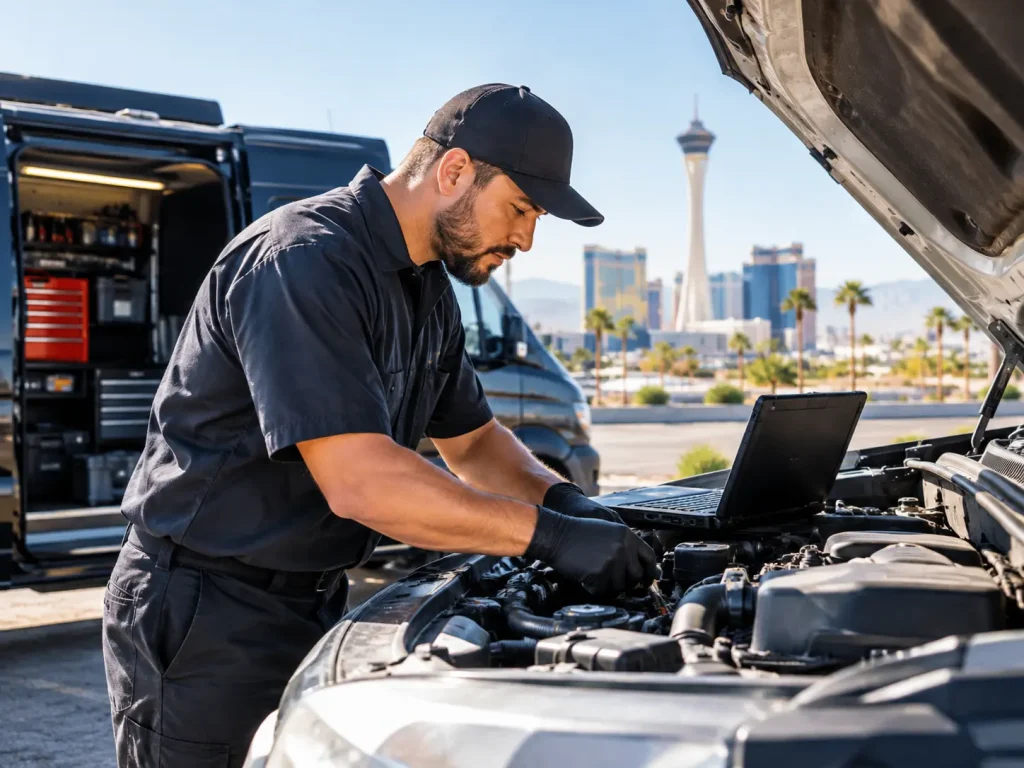
A car battery rarely gives up without a hint. More often it fades over weeks or months, sending small signals that most drivers miss or explain away. Then one morning the car will not start, and you are late, stuck, and searching for help. Learning the warning signs of a dying car battery gives you time to act before that happens. This guide explains the most common symptoms, what causes a battery to fail, how to test it, and when it is time to call for battery replacement in Fayetteville.
What Does a Car Battery Actually Do?
The battery has one big job and several small ones. Its main task is to supply the burst of power that cranks the starter and gets the engine running. Once the engine is on, the alternator takes over and recharges the battery while powering the electrical system. The battery also steadies the voltage for the computers, lights, radio, and other electronics. When it weakens, all of those systems can be affected, which is why the symptoms are not always limited to starting trouble.
Warning Signs Your Battery Is Dying
1. Slow or Sluggish Engine Cranking
This is the classic sign. When you turn the key or press the start button, the engine turns over more slowly than usual, with a drawn out sound instead of a quick start. A healthy battery cranks the engine briskly. A weak one struggles, especially on cold mornings or after the car has been sitting.
2. Clicking Noise When You Try to Start
A rapid clicking sound usually means the battery has enough power to engage the starter relay but not enough to turn the engine. If you hear that sound, the battery is a prime suspect, though corroded or loose connections can cause it too.
3. Dim Headlights and Interior Lights
If your headlights look weaker than normal, or they dim when you start the car or run the air conditioning, the battery may not be holding a strong charge. Interior lights that flicker or look yellowish point in the same direction.
4. Dashboard Warning Light
A battery or charging system light on the dashboard can mean the battery is failing, but it can also indicate a problem with the alternator or the wiring. Either way, it is a signal to have the electrical system checked soon. Some cars also show a low voltage message on the information display.
5. Electrical Gremlins
Power windows that move slowly, a radio that resets, a clock that loses time, or an infotainment screen that behaves strangely can all be symptoms of low or unstable voltage. Modern cars rely on many computers, and they are sensitive to a weak battery.
6. Swollen or Cracked Battery Case
Extreme heat or cold, age, and overcharging can cause a battery case to swell or crack. If the case looks bloated or damaged, the battery needs to be replaced. Handle it carefully, since the contents are corrosive.
7. Corrosion on the Terminals
White, blue, or green crust around the battery posts is corrosion. A small amount can build up on any battery, but heavy buildup can block the flow of electricity and cause starting problems. Sometimes cleaning the terminals solves the problem, and sometimes the corrosion is a sign of a leaking or aging battery.
8. A Bad Smell Near the Battery
A rotten egg smell can indicate that the battery is leaking or overheating. This is a safety concern. Keep sparks and flames away from the battery and have it inspected right away.
9. The Battery Is Simply Old
Even without symptoms, age matters. Many car batteries last roughly three to five years, though the real figure depends on the battery, your driving habits, and the climate. If yours is in that range or older, it is wise to have it tested instead of waiting for it to fail. Look for a date code on the battery label, or ask a technician to read it.
10. You Need Jump Starts More Than Once
If you have needed a jump start more than once in a short period, the battery is probably not holding a charge, or something is draining it. A jump may get you going, but it does not solve the underlying problem.
What Causes a Battery to Die?
- Age and normal wear, since every battery has a limited service life
- Extreme heat, which speeds up internal damage and can shorten battery life
- Cold weather, which reduces power output and exposes weak batteries
- Short trips that never give the alternator time to recharge the battery
- Leaving lights, chargers, or accessories on while the car is off
- A failing alternator that does not keep the battery charged
- Corroded or loose terminals and cables
- A parasitic drain, where a component keeps drawing power with the car off
- Vibration from a loose battery hold down bracket
- Long periods of sitting unused
Our article on keeping a reliable car for Fort Liberty commuters in Fayetteville explains how daily driving habits and routine upkeep affect parts like the battery. Drivers who spend long stretches in traffic or take lots of short trips may see batteries wear differently from those who drive steadily on the highway.
Is It the Battery or Something Else?
A car that will not start does not always have a bad battery. The alternator, starter, fuel system, and sensors can all cause similar symptoms. Here are a few clues that can help:
- If the car starts after a jump and keeps running, the battery is a likely culprit
- If the car starts after a jump but dies soon after, the alternator may not be charging
- If the engine cranks strongly but will not fire, the problem may be fuel or spark
- If you hear a single loud click and nothing else, the starter or a connection may be at fault
- If everything is completely dead, check for a loose or corroded terminal
Our guide to the top 10 reasons your car won’t start and how to get back on the road goes through these causes in more detail, so you can narrow down what is going on.
How Is a Battery Tested?
You do not have to guess. A technician uses a battery tester to measure the battery’s voltage and its ability to deliver power under load. A charging system test checks the alternator and the connections. These tests are quick, and they can tell you whether the battery is healthy, weak, or ready for replacement. Some testers also report how much life remains. A test is far better than replacing a battery on a hunch, and it can also reveal when the battery is fine and the real problem lies elsewhere.
Can You Extend the Life of Your Battery?
You cannot make a battery last forever, but good habits help.
- Keep the terminals clean and the cables tight
- Make sure the battery is secured so it does not vibrate
- Take longer drives now and then so the battery can recharge fully
- Turn off lights and accessories before you leave the car
- Park in a garage or the shade when possible, since heat wears batteries down
- Have the battery and charging system tested once a year, and more often as it ages
- If the car will sit for a long time, ask a technician about a battery maintainer
When Should You Replace the Battery?
Replace the battery when testing shows it can no longer hold a charge, when the case is swollen or leaking, when it is well past its expected life and showing symptoms, or when repeated jump starts are needed. Waiting for a complete failure usually means a breakdown at an inconvenient place and time. When you choose a replacement, match the size, type, and power rating your vehicle requires, which your owner’s manual lists. Some newer vehicles also need the new battery registered with the car’s computer after installation, so ask the technician whether that applies to yours.
Battery Replacement With a Mobile Mechanic
Replacing a battery is something a mobile mechanic can often do right where your car sits. A technician can come to your home or workplace in the Fayetteville area, test the battery and charging system, replace the battery if needed, clean the terminals, and make sure everything is working before they leave. That saves you a tow and a trip to the shop. Some vehicles have batteries in hard to reach spots or need special procedures, and a trustworthy technician will tell you honestly if a job needs a full shop. When you book, share your vehicle’s year, make, model, and any symptoms you have noticed so the right battery is on hand.
Do Not Wait for the Final Warning
A dying battery almost always leaves clues. Slow starts, dim lights, strange electrical behavior, and an older battery are all reasons to schedule a test. Catching the problem early costs less than an emergency, and it means you decide when and where the work happens instead of the battery deciding for you.
To learn more about our services, visit our homepage. If you think your battery is on its way out, reach out through our contact us page and we will come to you anywhere in the Fayetteville area.