
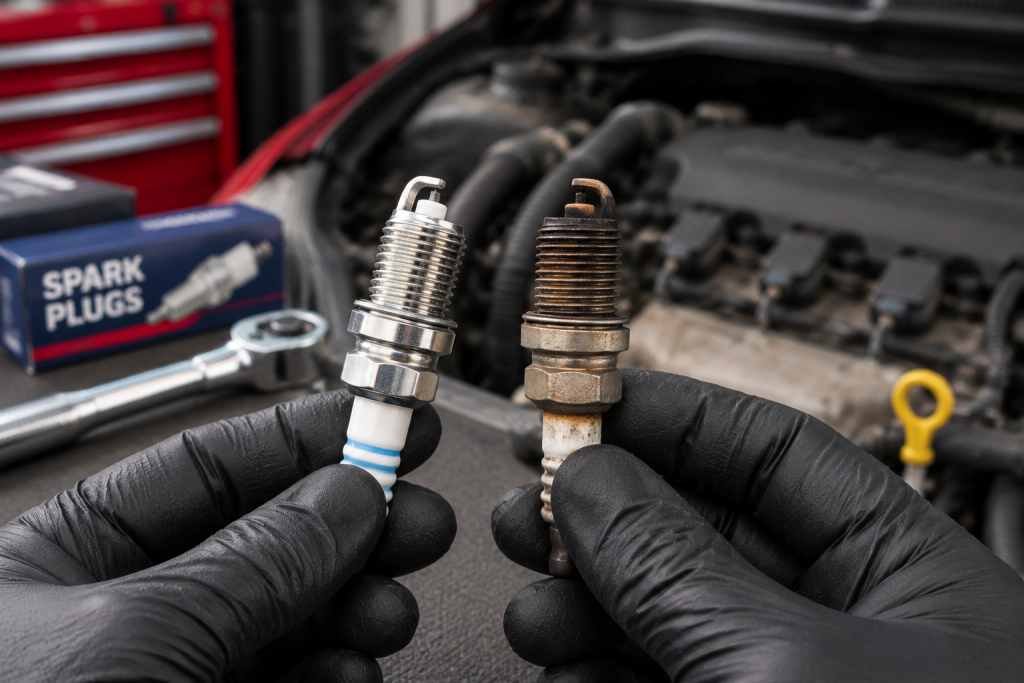
Spark plugs are small parts with a big job. Every time the engine runs, they create the spark that ignites the fuel and air mixture inside each cylinder, thousands of times a minute. They sit in one of the harshest environments in the car, surrounded by heat, pressure and combustion byproducts, and over time they wear out. When they do, the engine rarely fails all at once. Instead it starts to run a little worse, a little rougher and a little less efficiently. Knowing the signs of worn spark plugs can help you catch the problem early and avoid the trouble that comes from letting it go. This guide covers what spark plugs do, the symptoms of worn ones, how often they need to be replaced in general terms, what else can cause similar problems and what to expect from the repair. If you are looking into spark plug replacement in Fayetteville, here is where to start.
What Spark Plugs Do
A spark plug has a center electrode and a ground electrode separated by a small gap. When the ignition system sends a high voltage pulse to the plug, a spark jumps across that gap and lights the fuel and air mixture in the cylinder. The resulting burn pushes the piston down and turns the engine. For that to work well, the spark needs to be strong, well timed and consistent.
Over time, the electrodes wear down and the gap grows. Deposits from fuel and oil can build up on the tip. The spark gets weaker or less reliable, and combustion becomes less efficient. In a healthy engine, replacing plugs on schedule keeps combustion clean and consistent.
Signs Your Spark Plugs May Need Replacing
Rough idle
One of the most common signs is an engine that shakes or runs unevenly when you are stopped at a light or in park. Worn plugs can cause a cylinder to fire poorly at low speeds, and you may feel a stumbling or vibration through the seat and steering wheel.
Misfires
A misfire happens when a cylinder fails to ignite properly. It can feel like a stumble, a jerk or a brief loss of power, sometimes with a popping or sputtering sound. Misfires can happen at idle, under acceleration or at steady speeds.
Hard starting
Weak plugs can make the engine take longer to start, especially in cold weather, when the ignition system has to work harder. If the engine cranks normally but is reluctant to fire, plugs are one possible cause.
Poor fuel economy
When combustion is incomplete, fuel is wasted. If you are filling up more often than you used to, and driving habits have not changed, worn plugs may be part of the reason. Many other things can also affect fuel economy, such as tire pressure and other engine issues.
Hesitation and sluggish acceleration
If the car feels flat when you press the pedal, hesitates before speeding up or struggles on hills and when merging, weak ignition can be a cause.
Loss of power
An engine that does not seem to have its usual strength may have worn plugs or related ignition trouble, particularly under load.
Engine knocking or pinging
Rattling or pinging sounds during acceleration can point to combustion problems, though they can also come from fuel quality, carbon buildup or other issues. Do not ignore a new knocking sound.
A check engine light
Misfires are one of the most common reasons for the check engine light. A steady light means the car should be checked soon. A flashing light is more serious and often signals an active misfire. Unburned fuel can overheat the catalytic converter, so if the light is flashing, reduce your speed, avoid hard acceleration and heavy loads and get the car checked promptly. Your owner’s manual explains the warning lights on your dashboard.
Visible wear on the plugs
When a technician pulls the plugs, they can read a lot from them. Worn or rounded electrodes, a wide gap, heavy carbon deposits, oil fouling or a damaged insulator are all signs the plug is past its best. The condition of the plugs can also point to other engine problems, such as oil leaking into the cylinder or a mixture that is too rich or too lean.
How Often Should Spark Plugs Be Replaced?
There is no single answer, because it depends on the vehicle and the type of plug. Different engines use different plugs, and some are designed to last much longer than others. Common types include copper plugs, which wear faster, and platinum or iridium plugs, which are designed to last longer. The right interval for your car is listed in your owner’s manual, usually in the maintenance schedule. Follow that guidance instead of a general rule, and do not stretch it far past the recommendation. If your driving conditions are harder than average, such as lots of short trips, heavy stop and go traffic or frequent towing, your manual may suggest a different schedule.
If you bought a used car and do not know the history of the plugs, it is worth having a technician check them. Do not assume they were done.
Why Waiting Too Long Causes Trouble
- Worn plugs strain the ignition system. A widening gap makes the ignition coils work harder, which can shorten their life.
- Misfires can damage the catalytic converter. Unburned fuel passing into the exhaust can overheat this part.
- Fuel is wasted, and the engine runs less efficiently.
- Plugs can become harder to remove. Plugs left in too long can seize in the cylinder head, which turns a simple job into a more difficult one.
- It can leave you stranded. A badly misfiring engine may stall or fail to start.
Other Problems That Can Look Like Bad Spark Plugs
Many symptoms overlap with other issues, which is why diagnosis matters. Similar symptoms can come from:
- Failing ignition coils or wires.
- A weak battery or charging system. If the car is slow to start or acts strangely, the battery may be to blame. Our post on signs your car battery is dying can help you tell the difference.
- Dirty or failing fuel injectors, or a weak fuel pump.
- A clogged air filter or a dirty mass airflow sensor.
- Vacuum leaks.
- Faulty oxygen or other engine sensors.
- Low compression or internal engine problems.
A scan for stored codes and a hands on inspection can usually show whether plugs are the cause. Replacing parts without a diagnosis is just a guess.
Reliability for Daily Drivers
If you drive a lot, especially on a long commute, a car that runs rough or hesitates is more than annoying. It can leave you stranded far from home. Regular maintenance keeps a daily driver dependable. Our guide on keeping a reliable car for Fort Liberty commuters in Fayetteville covers other habits that help keep a car ready for the road.
What Happens During Spark Plug Replacement
The basic process is straightforward, though details vary by engine.
- The engine should be cool, since plugs sit in a hot cylinder head.
- The technician removes covers and disconnects the ignition coils or wires, taking care not to damage connectors.
- Debris around the plugs is cleaned away so it does not fall into the cylinder.
- The old plugs are removed and inspected, and their condition is noted.
- New plugs of the correct type and gap are installed, and tightened to the manufacturer’s torque specification.
- Coils or wires are reinstalled, and the car is started and checked for smooth running.
Using the right plug type is important, and so is correct tightening. Overtightening can damage the cylinder head threads, while undertightening can cause poor heat transfer and leaks. This is why many people choose a professional. On some engines, getting to all the plugs means removing other parts, such as the intake manifold, which takes more time and care.
Tips for Healthy Ignition
- Follow your owner’s manual for the plug type and interval.
- Replace the plugs as a set, not just one or two.
- Use the correct plug specified for your engine.
- Pay attention to early symptoms, such as rough idle or hesitation.
- Do not ignore a check engine light, especially a flashing one.
- Keep up with other maintenance, such as air filters and fluids, since they affect how the engine runs.
- Use good quality fuel.
How a Mobile Mechanic Can Help
Spark plug replacement is a good job for a mobile mechanic. A technician can come to your home or workplace, scan for codes, look at the ignition system, inspect the old plugs and install the correct new ones. Most routine replacements can be done on site. Engines where the plugs are buried under other parts, or cases where a seized plug or a more serious problem turns up, may need more time or a shop. A good technician will tell you honestly what can be done where you are.
Quick Spark Plug Warning Checklist
- Rough idle or shaking.
- Misfires, stumbling or sputtering.
- Hard starting.
- Poor fuel economy.
- Hesitation or sluggish acceleration.
- Loss of power.
- Knocking or pinging.
- A check engine light, especially a flashing one.
If your car is showing any of these signs, do not wait for it to get worse. Visit the Mobile Mechanic Pros of Fayetteville homepage to learn more, or contact us to schedule a visit.